

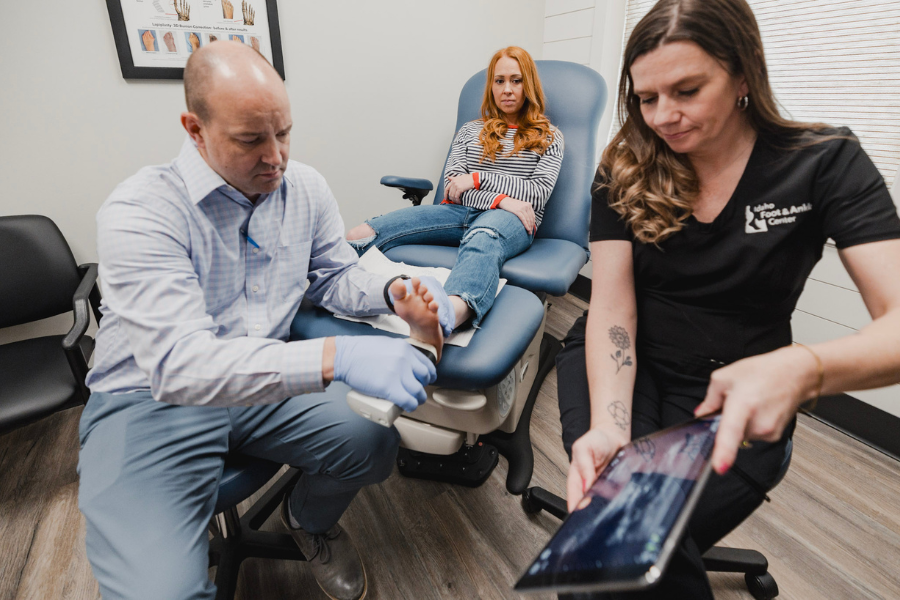
Foot or ankle pain can affect nearly every part of your day. It may make it harder to work, exercise, care for your family, or simply walk across a room comfortably.
When pain continues despite treatment, it’s natural to wonder whether foot surgery is the next step. The answer depends on the condition, its severity, how it affects your mobility, and whether nonsurgical care can provide meaningful relief.
At Idaho Foot & Ankle Center, we evaluate the entire problem before recommending a treatment plan. Surgery can be an effective solution, but it isn’t automatically the first or only option.
Our goal is to help you understand what’s causing your symptoms and choose the treatment that offers the best opportunity for lasting improvement. Our complete foot & ankle services include conservative treatments, advanced procedures, surgical care, and support throughout recovery.
Foot surgery may be recommended when a structural problem, injury, deformity, or chronic condition cannot be corrected adequately through nonsurgical treatment.
However, pain alone doesn’t always mean surgery is necessary. Some conditions respond well to immobilization, physical therapy, changes in activity, injections, laser therapy, or other forms of professional care.
We begin with a thorough evaluation. This may include discussing your symptoms, reviewing your medical history, examining your foot or ankle, evaluating your movement, and ordering imaging when needed.
We then consider several important questions:
A decision about surgery should be based on a clear diagnosis and a realistic understanding of the benefits, risks, recovery process, and available alternatives.
Surgery becomes more likely when a condition causes persistent pain, instability, deformity, loss of function, or a risk of further damage.
It may also be necessary when bones, joints, tendons, ligaments, or nerves are significantly damaged.
Common reasons for considering foot or ankle surgery include:
The type of procedure depends on the exact condition. Some surgeries repair damaged tissue, while others realign bones, stabilize joints, remove pressure from nerves, or correct deformities.
.png)
In many cases, we consider nonsurgical care before recommending an operation. The right approach depends on the diagnosis and whether delaying surgery could make the problem worse.
Professional nonsurgical treatment may include:
For certain conditions, mls laser therapy may be considered as a noninvasive option for managing pain and inflammation while supporting the healing process. The practice describes this treatment as FDA-cleared and designed to use concentrated light energy to stimulate healing.
Nonsurgical care isn’t simply a way to postpone an operation. When it’s appropriate, it may relieve symptoms, restore function, or help a condition heal without surgery.
However, continuing conservative treatment indefinitely isn’t always helpful. When a structural problem remains unchanged and symptoms continue to limit your life, surgery may offer a more effective long-term solution.
You don’t have to decide for yourself whether surgery is needed. That determination should be made after an examination by a qualified foot and ankle specialist.
Still, several symptoms indicate that it’s time to schedule a professional evaluation:
Sudden severe pain, an obvious deformity, an open wound, a suspected fracture, or an inability to bear weight should receive prompt medical attention.
The practice advises patients with an ankle injury to be evaluated quickly and notes that imaging may be ordered when a fracture is suspected.
Many foot and ankle conditions can become surgical concerns when they are severe, progressive, unstable, or resistant to other treatment.
A bunion is more than a bump near the big toe. It is a structural alignment problem that can gradually worsen and affect the way pressure moves through the foot.
Surgery may be considered when a bunion causes ongoing pain, limits footwear choices, interferes with walking, or continues progressing despite appropriate care.
We offer lapiplasty® 3d bunion correction for qualifying patients. This procedure is designed to correct the three-dimensional source of the deformity and stabilize the correction. The practice notes that appropriate patients may be able to walk within days following the procedure.
Not every bunion requires surgery. We evaluate its severity, flexibility, symptoms, progression, and effect on your daily activities before recommending treatment.
Hammertoes occur when one or more smaller toes become bent at the middle joint.
Flexible hammertoes may sometimes respond to nonsurgical care. A rigid, painful, or worsening deformity may require surgery to straighten the toe and relieve pressure.
Patients may notice rubbing inside shoes, painful corns, difficulty finding comfortable footwear, or pain beneath the front of the foot.
Some fractures remain properly aligned and can heal with immobilization. Others require surgery to return the bones to their correct positions and stabilize the injury.
Surgical treatment may be more likely when a fracture is displaced, unstable, involves a joint, breaks through the skin, or affects several bones.
Our team evaluates both ankle fractures and foot fractures to determine the safest and most effective treatment.
Early evaluation matters because a fracture that heals in the wrong position may lead to chronic pain, arthritis, weakness, or changes in walking.
The Achilles tendon connects the calf muscles to the heel and plays an essential role in walking, running, and pushing off the ground.
Minor injuries may respond to immobilization and rehabilitation. A complete rupture or serious chronic injury may require surgical repair, depending on the patient’s health, activity level, and treatment goals.
We evaluate each achilles tendon injury individually because no single treatment is right for every patient.
An ankle sprain can damage the ligaments that stabilize the joint. Many sprains heal successfully with professional treatment and rehabilitation.
Repeated sprains or severe ligament damage can leave the ankle loose and unstable. Surgery may be considered when the ankle repeatedly gives way despite appropriate rehabilitation and bracing.
Ongoing instability can also damage cartilage and increase the risk of future injuries.
A painful or progressive flatfoot may change alignment throughout the foot and ankle. It can place excessive strain on tendons, ligaments, and joints.
Some cases can be managed with orthotics, bracing, physical therapy, or other professional treatment. Surgery may become appropriate when the deformity progresses, pain remains significant, or joints and tendons are being damaged.
The goal of surgery may include restoring alignment, repairing a tendon, stabilizing a joint, or improving how the foot supports the body.
A neuroma is an irritated or thickened area of nerve tissue, commonly found in the forefoot.
Patients may experience burning, tingling, numbness, or the sensation of standing on a pebble. Professional nonsurgical care often comes first.
When symptoms remain severe, surgery may be considered to remove the damaged nerve tissue or release pressure around the nerve.
People with diabetes may face a greater risk of neuropathy, wounds, infections, poor healing, and structural changes in the foot.
Surgical treatment may sometimes be required to remove infected tissue, correct a deformity, stabilize damaged bones, reduce pressure, or help preserve the limb.
Consistent diabetic foot care is essential because a small problem can become serious without prompt treatment.\
.png)
A consultation is your opportunity to understand the condition and the available treatment paths.
We begin by listening carefully. We want to know where the pain occurs, how it started, what makes it worse, which treatments you’ve tried, and how it affects your life.
Your evaluation may include:
We’ll explain the diagnosis in plain language and describe why a particular treatment may or may not be appropriate.
When surgery is one option, we’ll discuss what the procedure is intended to correct, the expected recovery, possible risks, and reasonable alternatives.
You can learn more about our podiatrists before your visit. Our team provides specialized foot and ankle care through offices in Idaho Falls and Rexburg.
Preparation depends on the procedure, but the process begins well before the day of surgery.
We may review your medications, medical history, allergies, circulation, blood sugar control, and any conditions that could affect healing. Additional testing or clearance from another provider may be needed.
We’ll also explain practical details, including:
Following these instructions closely supports a safer and more predictable recovery.
Our new patients page includes office information, first-visit guidance, and forms that can be completed before an appointment.
Recovery varies widely. A smaller procedure may allow a relatively quick return to normal activity, while major reconstruction can require several months of healing and rehabilitation.
Your recovery timeline may depend on:
Swelling can remain for some time after many foot and ankle procedures. That doesn’t necessarily mean something is wrong, but we’ll explain what is expected and which changes require immediate attention.
Follow-up appointments are important because they allow us to monitor the incision, check alignment and healing, adjust protection, and guide your gradual return to activity.
Trying to return to normal activity too quickly can disrupt healing. Our team provides a structured plan based on your procedure and progress.
Understanding the plan can make the entire process feel more manageable.
Useful questions include:
We welcome questions. A well-informed patient is better prepared to participate in treatment and recovery.
Foot and ankle anatomy is complex. Each foot contains numerous bones, joints, muscles, tendons, ligaments, nerves, and blood vessels that work together with every step.
Choosing a provider who focuses specifically on these structures gives you access to specialized evaluation and treatment.
At Idaho Foot & Ankle Center, we’ve served patients in Eastern Idaho for more than 30 years. We provide care ranging from checkups and conservative treatment to advanced procedures and surgery.
Our approach is built around careful diagnosis, individualized treatment, and helping patients return to the activities they value.
Needing a surgical evaluation doesn’t mean you’ll automatically need an operation. It means your symptoms deserve a closer look and a clear treatment plan.
Persistent foot or ankle pain can gradually shrink your world. You may stop exercising, avoid certain shoes, turn down activities, or accept discomfort as part of everyday life.
We don’t believe foot pain should control your routine. Whether your best option is nonsurgical treatment, advanced therapy, rehabilitation, or surgery, we’ll help you understand the path forward.
Contact our support team to get more info and schedule an evaluation with our Idaho Falls foot and ankle specialists. The sooner we identify the source of the problem, the sooner we can begin working toward improved comfort, stability, and mobility.
Sometimes, but operating on both feet can make mobility and recovery more difficult. We consider the type of procedure, your health, your home support, and whether you’ll be able to follow postoperative restrictions safely.
Any operation involving an incision can leave a scar. Its size and appearance depend on the procedure, incision location, healing response, and postoperative care.
Age alone doesn’t determine whether surgery is safe. We evaluate overall health, circulation, mobility, medications, healing ability, and the expected benefits before making a recommendation.
Many medically necessary procedures are covered, but benefits vary by plan. Our office can provide the appropriate procedure information so you can confirm coverage, deductibles, and authorization requirements with your insurer.
September 4, 2026
Learn how hammertoes develop, which symptoms to watch for, and how professional treatment can reduce pain and improve alignment.
August 7, 2026
Learn how to recognize a foot corn, what causes it, and how professional podiatry treatment can relieve pain and prevent recurrence.
.png)
April 14, 2026
Get podiatrist-approved tips on choosing the best walking or running shoes for your foot type and activity level in Idaho Falls.
.png)
April 13, 2026
Idaho Falls podiatrists compare trail vs. road running foot risks and share expert tips for staying injury-free on any surface.